





 November 18, 2026
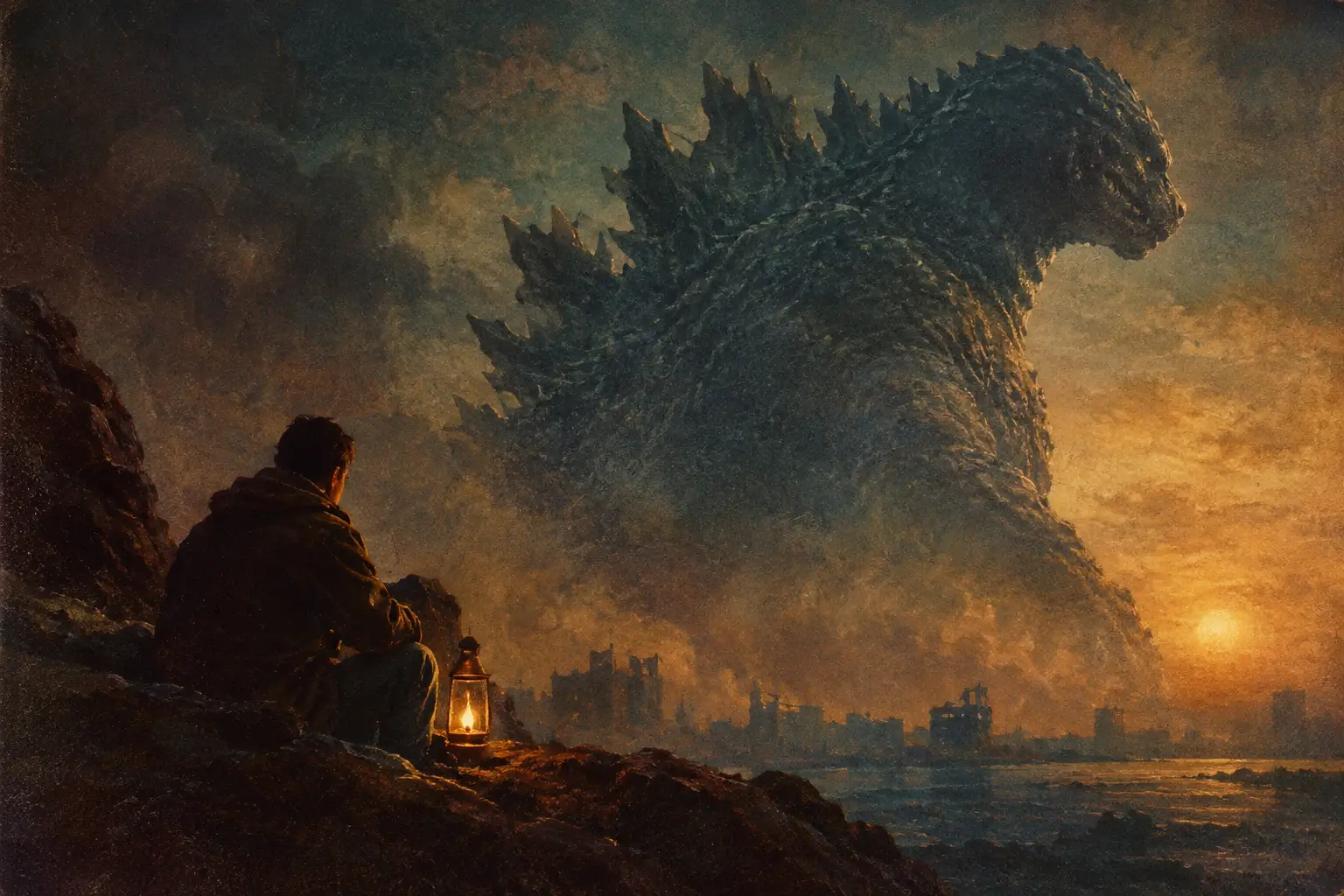
A charcoal-gray giant rises from the sea in Gojira (1954), and the first thing Japan sees is not a superhero problem waiting for a franchise solution. It sees catastrophe walking upright. The Godzilla nuclear allegory is often reduced to one tidy sentence – “Godzilla represents the atomic bomb” – but the original film is sadder, stranger, and much more specific than that.
Godzilla is not simply a prehistoric beast enlarged by radiation. He is a body made from postwar dread: Hiroshima and Nagasaki, yes, but also radioactive fallout, official reassurances, wrecked homes, scarred survivors, and the unnerving knowledge that modern science could make a whole city vanish before lunch. Not exactly a cheerful matinee. But this is why the film still has teeth.
Godzilla’s nuclear allegory began with a real 1954 fear
The timing matters. In March 1954, the Japanese fishing vessel Daigo Fukuryu Maru, often called Lucky Dragon No. 5 in English, was exposed to fallout from the United States’ Castle Bravo hydrogen-bomb test at Bikini Atoll. Its crew had been fishing outside the declared danger zone, yet radioactive ash fell on the boat. Radio operator Aikichi Kuboyama died later that year from radiation-related illness.
The incident horrified Japan. It also made nuclear danger feel current rather than historical. The bombs dropped in 1945 were not safely sealed behind museum glass. Fallout could travel over water, enter food chains, and arrive in the lives of people who had never seen a mushroom cloud. Gojira arrived in Japanese theaters that November, only months after the Lucky Dragon disaster.
That proximity is the key to the film’s charge. Director Ishiro Honda, producer Tomoyuki Tanaka, special-effects wizard Eiji Tsuburaya, screenwriter Takeo Murata, and story creator Shigeru Kayama were not assembling a generic monster yarn and accidentally stumbling into symbolism. They made a monster movie shaped by the nuclear anxieties all around them.
Even Godzilla’s first attacks recall the language of catastrophe. His atomic breath does not behave like a dragon’s fire. It flashes with the awful visual logic of a bomb blast. Burned ruins, civilians fleeing through smoke, and hospitals crowded with the injured evoke images Japanese audiences already knew too well. The suit may be rubber, but the grief is not.
Why the monster matters more than a metaphor
Calling Godzilla “a metaphor” can make him sound neat and academic, like a diagram in a lecture hall. He is messier than that. The creature is a disaster with a face, but he is also a victim of the same forces that make him dangerous. Nuclear testing awakens and transforms him. Humanity creates the conditions for his arrival, then panics when the bill comes due.
That gives the Godzilla nuclear allegory its unusual emotional pull. The film does not ask you to cheer when the monster stomps a city. It asks you to sit with the terrible fact that suffering can produce more suffering. Godzilla is not a criminal mastermind cackling atop Tokyo Tower. He is an irradiated consequence, lumbering through a world that has already learned what mass destruction looks like.
Honda understood the stakes personally. He had served in the Imperial Japanese Army and was held as a prisoner of war in China after Japan’s surrender. Accounts of his life often point to the devastation he encountered on his return to Japan as a formative experience. That biography does not turn every frame of Gojira into autobiography, naturally. Film history gets wobbly when every camera angle becomes a secret diary entry. But it helps explain the movie’s sober, mournful texture.
Akira Ifukube’s score does the rest of the emotional heavy lifting. Its funeral-march weight makes Godzilla feel less like a carnival attraction than an air-raid siren given legs. When the film pauses for mourning, it means it. The creature feature has put on a black tie and is staring into the abyss.
The movie refuses easy scientific heroics
Atomic Age science fiction often treats science as either a miracle cure or a mad-lab boogeyman. Gojira is more conflicted. It fears nuclear technology, but it does not pretend knowledge itself is the villain. Its real concern is what happens when discovery outruns moral responsibility.
That tension lives in Dr. Serizawa and the film’s devastating new weapon. The story does not present a simple “science bad” sermon. Instead, it recognizes a grim pattern: a tool devised to solve one unimaginable crisis can become the blueprint for the next one. The answer to an atomic monster may carry its own atomic-age curse.
This is where the original film remains prickly. It does not offer the audience a clean victory lap. It worries about what people will do with power once it exists. Frankly, that is more frightening than another oversized lizard knocking down a tiny electrical tower, beloved though that tradition may be.
The American recut changed the temperature
For many American viewers, the first encounter with Godzilla came through 1956’s Godzilla, King of the Monsters!, which added Raymond Burr as journalist Steve Martin and re-edited the Japanese film for U.S. release. The American version is historically important and, for plenty of fans, deeply nostalgic. Burr brings genuine gravity. This is not a case for tossing it into the sea.
Still, the recut changes the point of view. By placing an American observer at the center and trimming or reshaping material, it makes the experience more legible to a U.S. audience but softens some of the original film’s distinctly Japanese civic trauma. Gojira is rooted in a country living with the aftermath of nuclear attack and the fresh terror of radioactive contamination. The American edit often feels more like a crisis witnessed from the outside.
That distinction is worth protecting, especially because the later Godzilla series became so gloriously elastic. Over the decades, Godzilla could be protector, villain, dad-adjacent weird uncle, environmental warning, wrestling champion, and the only kaiju who could make a victory dance look like a labor dispute. Those shifts are part of the character’s magic. But they can make it easy to forget how severe the 1954 foundation is.
Godzilla is not only about Hiroshima and Nagasaki
The original film absolutely carries the shadow of Hiroshima and Nagasaki. It would be nonsense to deny that. Yet saying Godzilla “is Hiroshima” flattens the movie and the history behind it.
The film also speaks to nuclear testing in the Pacific, Cold War escalation, contamination anxiety, survivor trauma, and the fear that governments may treat ordinary people as acceptable collateral damage. Japan’s relationship to nuclear memory is not one single feeling, either. It includes mourning, anger, peace activism, censorship during the U.S. occupation, and difficult questions about wartime responsibility. A monster movie cannot contain all of that. It can, however, give those anxieties a shape loud enough to haunt the shoreline.
That is why the allegory travels. Viewers outside Japan can recognize the fear of technological power without ownership, but we should not sand away the film’s Japanese context to make it universally vague. Godzilla belongs to the world now. His first roar came from a very particular wound.
What later Godzilla films keep, and what they change
Later entries revisit nuclear dread in different keys. The Return of Godzilla (1984) brings Cold War tension back to the foreground. Godzilla vs. Biollante (1989) tangles with biotechnology and corporate ambition. Godzilla Minus One (2023) returns to postwar Japan with a fierce interest in survivor guilt, collective responsibility, and the value of individual lives.
None simply repeats Gojira, nor should they. An allegory that never changes becomes a museum exhibit with excellent tail maintenance. The lasting power of Godzilla is that he can absorb new fears while retaining the radioactive ache of his origin.
For a dark winter-night rewatch, try the 1954 Japanese Gojira with its historical moment in mind. Do not approach it as homework, and do not wait for it to behave like a modern blockbuster. Let its silences, funeral weight, and shabby-beautiful miniature ruins work on you. Godzilla’s first great trick was not making us fear a monster. It was making us recognize what made him possible.


 Prev Post

What do you think?
Show comments / Leave a comment