





 November 6, 2026
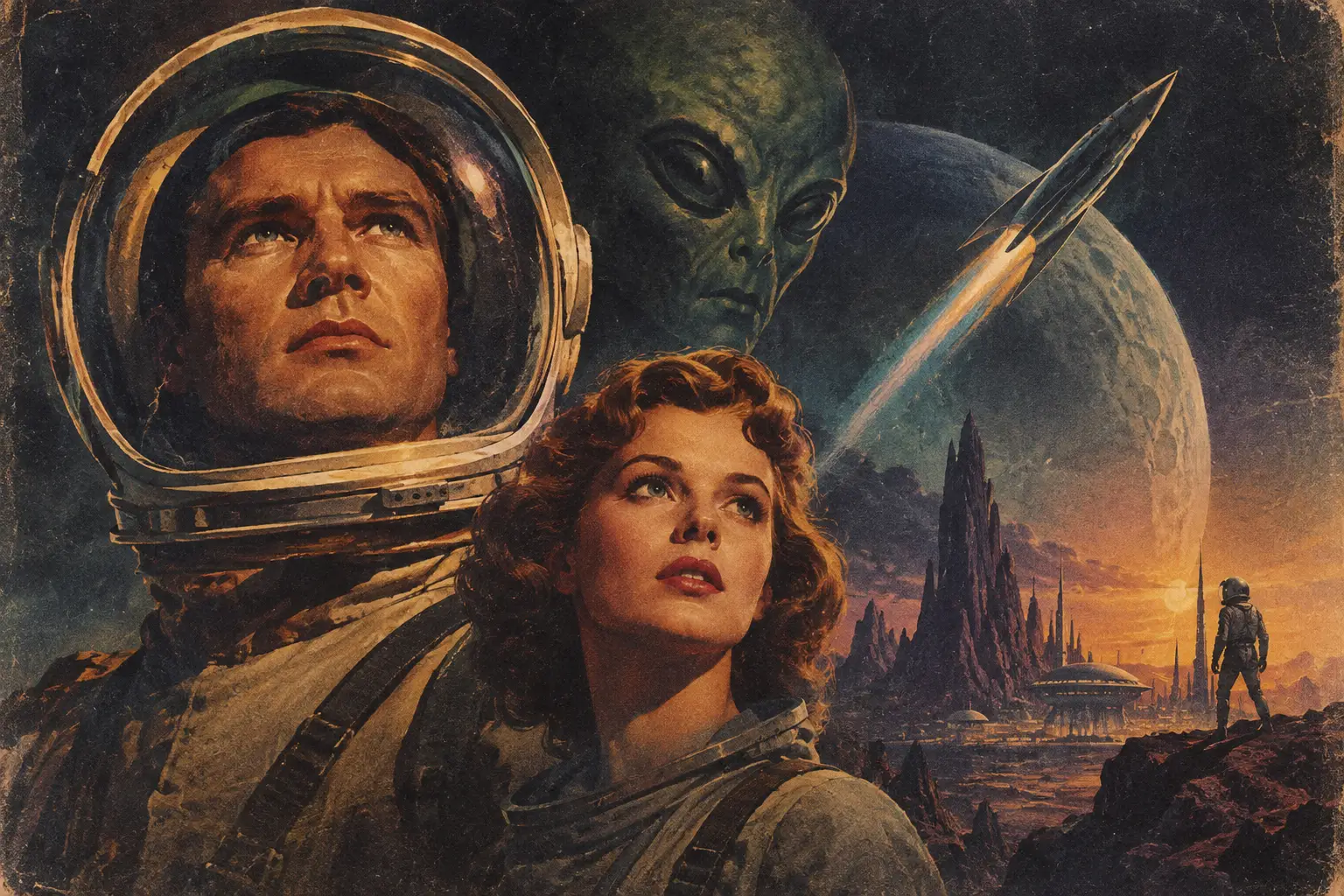
A rocket dangling from a wire is not the point. A rubber creature with a zipper is not the point either, though we salute both. The best vintage science fiction films endure because they took the newest anxieties of their day – industrial labor, war, atomic power, conformity, space itself – and gave them a face you could see across a dark theater.
That is the trick of old sci-fi. Its technology dates. Its fears do not. These films are not a museum tour of quaint gadgets; they are strange little transmissions from people who suspected the future might be marvelous, horrifying, or both before dinner. Start here if you want the canon with its bolts still showing.
The best vintage science fiction films are not all rockets
A useful vintage sci-fi watchlist needs room for expressionist nightmares, Soviet grandeur, British chillers, and the kind of 1950s American paranoia that makes a suburban dinner party look like hostile territory. These 12 films span roughly 1927 to 1971, but they share a willingness to make big ideas physical, eerie, and occasionally magnificently impractical.
Metropolis (1927)
Fritz Lang’s Metropolis is the grandparent of more dystopias than can comfortably fit in one city of towering Art Deco buildings. Its influence is obvious in everything from robot design to the visual language of the future, but influence is not why it remains vital. The film is a fever dream about class, labor, and the human cost of efficiency, made when the machine age still seemed capable of swallowing the whole world.
Its famous robot has become an icon, naturally. But the film’s lasting power is in its architecture: the wealthy literally live above the workers who keep their glittering fantasy alive. Subtle? Not even slightly. Memorable? For nearly a century, yes.
Things to Come (1936)
Written by H. G. Wells and directed by William Cameron Menzies, Things to Come has the confidence of a film that believes it has seen the next hundred years. Its future-history structure makes it unusual even now, moving from war and collapse toward an austere, technological civilization.
Some of its predictions miss by a country mile. That is part of the fun. Yet its central question remains uncomfortably fresh: when civilization breaks, who gets to define what rebuilding means? The answer here is fiercely pro-science, though not nearly as uncomplicated as people sometimes remember.
The Day the Earth Stood Still (1951)
Robert Wise’s The Day the Earth Stood Still is what happens when a major-studio alien visitation movie decides its real monster is international brinkmanship. Released six years after Hiroshima and Nagasaki, it carries the chill of a world that had discovered it could end itself.
Michael Rennie’s Klaatu is calm, formal, and almost unnervingly adult. That matters. The movie’s extraterrestrial visitor is not a bug-eyed invader to be blasted with a ray gun; he is an emissary arriving with a moral ultimatum. Bernard Herrmann’s theremin-heavy score does the rest, making the air itself feel alien.
The Thing from Another World (1951)
Before the 1982 version turned Antarctic isolation into a master class in distrust, Christian Nyby’s The Thing from Another World gave us a leaner, faster Atomic Age creature feature. Howard Hawks’ influence is all over its clipped dialogue and overlapping banter, which makes the scientists and military men feel less like stock figures than a stressed-out workplace crew with a plant monster outside.
The science-versus-force tension is its real engine. The film is too clever to insist either side has all the answers, even if it very much wants you to remember that curiosity needs a fire extinguisher nearby.
The War of the Worlds (1953)
Byron Haskin’s The War of the Worlds takes H. G. Wells’ Victorian invasion nightmare and drops it into postwar California, where the sunny suburbs suddenly look terribly exposed. The Martian war machines remain beautiful bits of design: sleek, floating, and almost too elegant to be trusted. A lesson for us all.
What lands hardest is the movie’s scale. The attack does not feel confined to one unlucky town or laboratory. Civilization seems to be coming apart on radio broadcasts and crowded roads, giving the film the nervous pulse of an emergency nobody can quite grasp.
Godzilla (1954)
Ishirō Honda’s original Godzilla belongs on any serious list of vintage science fiction, even if American marketing spent decades trying to file it under monster mayhem and call it a day. The creature is a product of nuclear testing, but Honda’s film is not simply anti-bomb propaganda in a rubber suit. It is a national trauma rendered immense enough to walk through a city.
The Japanese title, Gojira, matters because this is not the comic-book mascot many later audiences know. Akira Ifukube’s score, the mournful aftermath, and the terrible implications of the Oxygen Destroyer give it a weight that cheap imitation could never manage. The suit is not a limitation. It is the ghost in the room.
Invasion of the Body Snatchers (1956)
Don Siegel’s Invasion of the Body Snatchers has inspired decades of arguments about what, exactly, its pods represent: communism, consumer conformity, postwar domesticity, anti-communist hysteria, or plain old terror of losing the people you love. The correct answer is that the film is roomy enough to hold all of those readings.
Its genius is making emotional flatness frightening. The threat is not merely death. It is a world where nobody grieves, jokes, desires, or worries. For a culture that often treats feelings as an inconvenience, that is a rather pointed little nightmare.
When the future got weird, intimate, and political
The Incredible Shrinking Man (1957)
Jack Arnold’s The Incredible Shrinking Man begins with a wonderfully pulpy premise and ends somewhere unexpectedly cosmic. Richard Matheson’s script understands that bodily transformation is never just a special-effects assignment. It changes a marriage, a home, a sense of dignity, and eventually a person’s place in the universe.
Grant Williams gives the film its aching center. The spider and cat are famous, and deservedly so, but the quiet despair is what lingers. This is monster cinema with existential frost on the windows.
Village of the Damned (1960)
Wolf Rilla’s British chiller turns a tidy village and a group of unnervingly composed children into an argument about authority, reproduction, and social control. The children are not wild or noisy. They are polite, synchronized, and impossibly certain. Frankly, that is worse.
The film’s black-and-white imagery gives its supernatural science-fiction premise a cold, clinical beauty. It also trusts silence, stillness, and adult helplessness more than spectacle. If you like your cosmic dread served with a proper cup of tea and a thousand-yard stare, this is your stop.
The Time Machine (1960)
George Pal’s adaptation of H. G. Wells is often remembered for its marvelous time-lapse journey and the Morlocks, but its real interest lies in the bitterness beneath its adventure-story polish. This future is not a triumph of progress. It is a divided society that has made peace with its own terrible arrangement.
The production design has storybook appeal, and that contrast sharpens the unease. Pal understood that a beautiful future can be just as alarming as a grimy one, particularly if it asks you not to look below ground.
Planet of the Apes (1968)
Franklin J. Schaffner’s Planet of the Apes arrived at the end of a decade shaken by war, civil rights struggles, political violence, and a deepening suspicion that technological progress had not improved human beings nearly enough. Its makeup is a technical landmark, but the film works because Rod Serling and Michael Wilson’s script gives its ape society real ideological friction.
This is not a film about humans meeting funny monkeys. It is about prejudice wearing official robes, knowledge being managed by institutions, and civilization’s talent for repeating its worst habits with great confidence. The famous final image gets all the postcards, but the movie earns it.
Solaris (1972)
Andrei Tarkovsky’s Solaris sits just beyond the usual Atomic Age boundary, but it belongs in this candlelit cabinet because it offers one of vintage science fiction’s most haunting corrections to the space-race fantasy. Space is not a frontier to conquer here. It is an unknowable presence that turns memory, guilt, and love back upon the people trying to study it.
Do not choose Solaris expecting laser battles or brisk pacing. Choose it on a dark winter night when you are willing to let a film unsettle you gently, then thoroughly. Tarkovsky makes the future feel old, sorrowful, and intimate.
Pick the right doorway into the past
If you want Atomic Age nerves and brisk thrills, begin with The Day the Earth Stood Still, Godzilla, or Invasion of the Body Snatchers. If you want grand, shadowy visions of social collapse, choose Metropolis, Things to Come, or Planet of the Apes. And if your tastes run toward melancholy cosmic weather, The Incredible Shrinking Man and Solaris will meet you there.
The oldest effects may show their seams, but that is not a defect to forgive. It is part of the invitation. These films were made by artists trying to picture what had not happened yet, with paint, glass, wire, light, rubber, and a startling amount of nerve. Put one on, lower the lights, and let the future arrive in black and white.


 Prev Post

What do you think?
Show comments / Leave a comment