





 November 26, 2026
A Universal Monsters movie can turn a dark winter night into a visit with old friends, which is a peculiar thing to say about murderers, grave robbers, and one extremely damp lagoon resident. Yet that is the enduring trick. These films did not become immortal because they were simply frightening – though a shadow creeping up a staircase could still do the job. They became a shared emotional language because Universal gave its monsters personalities, faces, and a place to return to.
That last part matters. We often talk about the studio as if it built a grand master plan called the cinematic universe. It did not. Nobody in 1931 was pinning color-coded cards to a wall and asking whether Dracula could boost the Wolf Man’s second-act stakes. Universal was making commercial horror pictures in an anxious era. What emerged, through talent, repetition, and a little glorious continuity chaos, was something more intimate: a haunted repertory company.
Universal Monsters Were Never Just a Brand
The familiar cycle began with Dracula and Frankenstein in 1931, two films that established the studio’s basic vocabulary. There were European castles, laboratory towers, storm clouds, strange accents, and enough fog to make a meteorologist nervous. But the deeper connection was tonal. Both pictures treated monstrosity as a condition with consequences, not merely a costume waiting for a torch-bearing crowd.
Bela Lugosi’s Count is elegant, predatory, and sealed off from ordinary human life. Boris Karloff’s creature is something far more painful: a being brought into the world without any map for surviving it. The distinction is crucial. Universal horror gave us villains, certainly, but it also gave us outsiders. That is why these characters could keep changing shape without losing their pull.
The studio’s early sound horrors were not all cut from the same cloth. Karl Freund’s The Mummy from 1932 is a hushed romantic nightmare. James Whale’s The Invisible Man from 1933 is brisker, stranger, and gleefully nasty. Whale’s Bride of Frankenstein in 1935 is practically a gothic cabaret performed beside an operating table. Still, each one belongs in the same candlelit room.
Universal’s great advantage was not perfect consistency. It was a recognizable atmosphere. The films understood that old castles, crackling machinery, funeral-black clothes, and cobwebbed staircases could create a mood before a creature ever entered the frame. The sets were physical, the makeup was physical, and the shadows had weight. You can almost smell the dust in the laboratory. That matters more than a hundred polished digital bats.
The Emotional Monsters Made the Difference
The most durable Universal Monsters are not frightening because they are unknowable. They are frightening because we understand just enough.
Frankenstein’s creature wants connection and receives fear. Larry Talbot, introduced in 1941’s The Wolf Man, knows what he becomes and dreads it anyway. The Mummy is consumed by impossible devotion. Even the Creature from the Black Lagoon, who arrived much later in 1954, carries the lonely ache of something cornered in its own ancient world.
That emotional clarity is the studio’s real legacy. Universal made monsters into figures of grief, isolation, bodily change, forbidden desire, and bad family decisions. Especially bad family decisions. The Frankensteins could have saved everyone a lot of trouble by taking up stamp collecting.
This does not mean the films are delicate tragedies without teeth. Universal knew how to land an image: Karloff’s outstretched hands, Lugosi’s fixed stare, Chaney’s wolfish silhouette under the full moon. But the scares work because the movies let their creatures be vulnerable. The Monster is often hunted, exploited, misunderstood, or dragged back to life by somebody who absolutely should not have access to electricity.
That balance is why the cycle speaks so clearly to horror fans now. Modern horror has plenty of monsters with trauma, and plenty of trauma with monsters. Universal helped establish the grammar. It did so with directness rather than speeches. Karloff’s creature does not need a monologue about social exclusion. One look at him trying to navigate a hostile village gets us there.
The Monster Rallies Turned a Cycle Into a Family
The idea that Universal’s creatures belong together largely comes from the crossover pictures, especially Frankenstein Meets the Wolf Man in 1943, House of Frankenstein in 1944, and House of Dracula in 1945. These were not airtight mythology-building exercises. They were monster rallies, and they could be messy in the way a family reunion gets messy when nobody agrees who is bringing dessert.
Continuity bends. Identities shift. The Frankenstein Monster has a remarkable talent for surviving apparent finales. Dracula’s rules are whatever the current picture needs them to be. But the movies gained something more valuable than lore precision: companionship.
Lon Chaney Jr. returned repeatedly as Larry Talbot, giving the Wolf Man a tragic throughline uncommon in studio horror of the period. Lugosi came back not only as Dracula but as the sinister Ygor, a character so vivid that he reshaped the Frankenstein films around him. Glenn Strange’s Monster had a massive, mournful presence suited to the later entries. These performers made the recurring world feel inhabited.
The crossovers also made the monsters feel less like isolated nightmares and more like members of the same strange community. A Universal castle is not just a location. It is a neighborhood with terrible zoning laws.
There is a trade-off, of course. If you come to the later films expecting the concentrated visual invention of Frankenstein or the emotional grandeur of Bride of Frankenstein, you may find a brisker, more programmatic machine at work. Wartime budgets and changing audiences had their say. But the rally films have their own warm, ramshackle pleasure. They understand that seeing these faces together is the event.
Television Made the Universal Monsters Ours
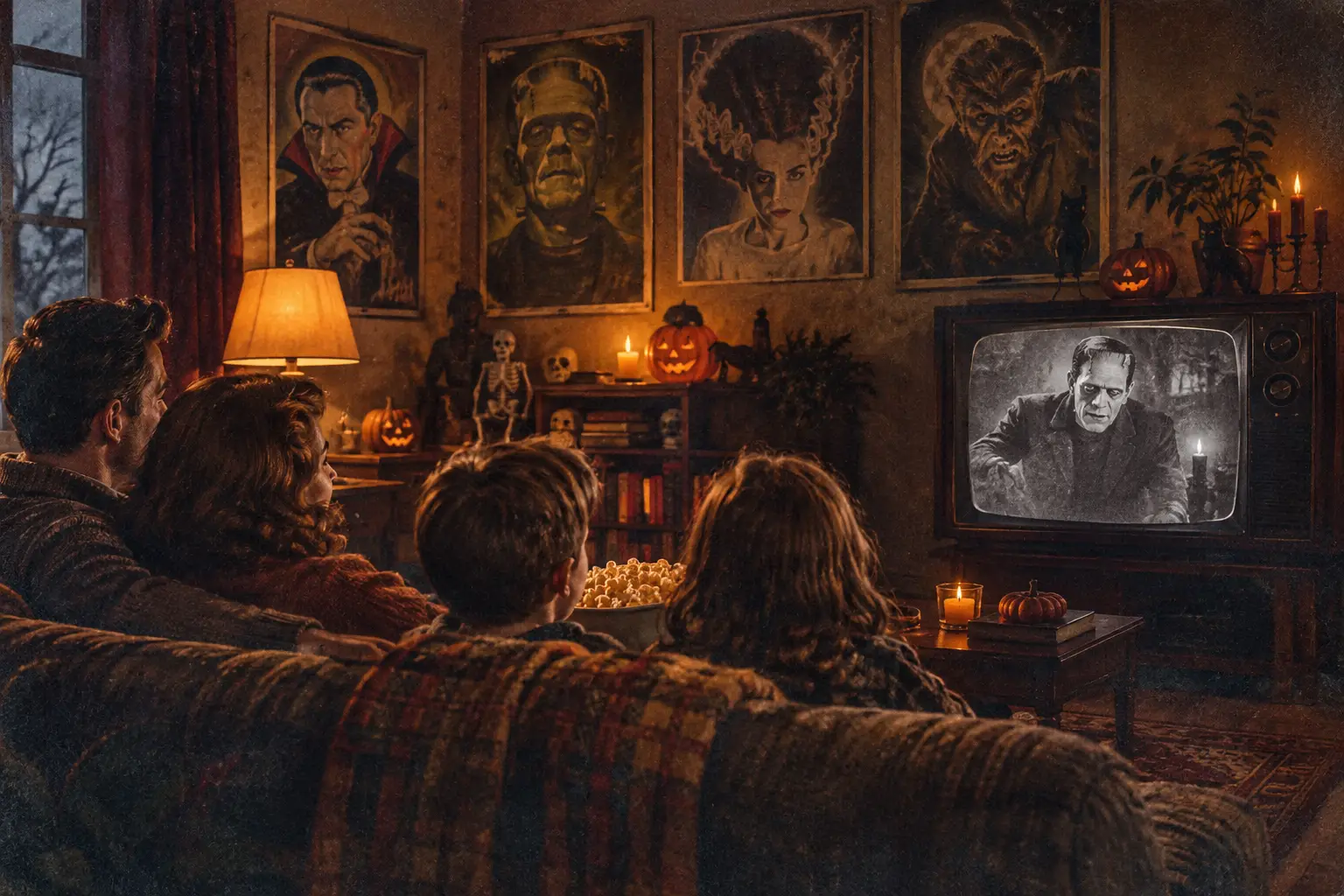
The cycle’s second life did not happen in a movie palace. It happened in living rooms.
In 1957, Screen Gems syndicated Shock Theater, a package of 52 pre-1948 Universal films, to local television stations. Suddenly Dracula, Frankenstein’s Monster, the Wolf Man, and their assorted cursed cousins became late-night companions for a new generation. They were hosted by local ghouls, watched from behind couches, and absorbed between commercials for pizza joints and used cars.
That television afterlife changed the meaning of the films. A child who caught The Mummy’s Hand on a Saturday afternoon did not necessarily see it as a lesser sequel. It was part of the big spooky family. Famous Monsters of Filmland, launched in 1958, and Aurora’s monster model kits, beginning in 1961, reinforced the same idea: these creatures were collectible, discussable, and available for imaginative rearrangement.
That is why arguments over the “real” Universal Monsters lineup can get silly fast. The core figures are clear enough, but the wider family has always been porous. Does the Phantom count? Naturally. What about the Hunchback? More complicated, but the question itself is part of the fun. The cycle was never a tidy spreadsheet. It was a haunted attic, and every fan has a favorite trunk to open.
How to Return to Universal’s Haunted House
If it has been a while, resist the urge to treat the films as homework. Pick a mood. For melancholy gothic grandeur, pair Frankenstein with Bride of Frankenstein. For a sadder, autumnal evening, let The Wolf Man lead into Frankenstein Meets the Wolf Man. For pure creature-feature comfort, visit Creature from the Black Lagoon and its first sequel, Revenge of the Creature.
Watch for the small human choices rather than hunting only for famous images. Notice the way a scientist looks at a creation, the way villagers react to someone different, the way a monster reaches before it strikes. These movies move quickly, but they leave room for a flicker of pity. That flicker is the whole electrical storm.
The Universal Monsters still feel like family because they were built to return. They return in sequels, on television sets, in model-kit boxes, in Halloween decorations, and in the part of us that recognizes a lonely creature stumbling toward the light. Put one on when the night gets long. The old castle door is already open.


 Prev Post

What do you think?
Show comments / Leave a comment