





 November 24, 2026
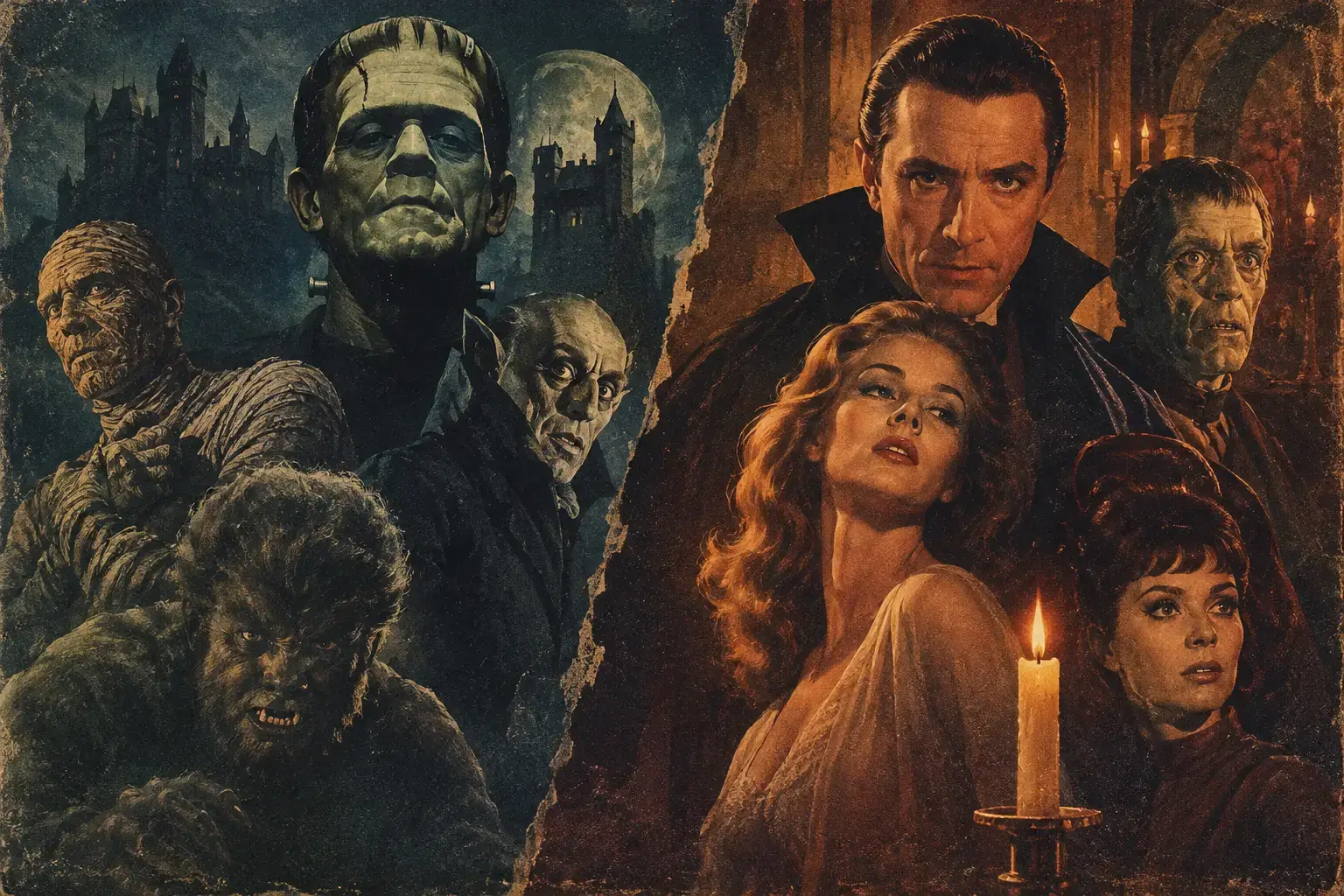
A laboratory storm cracks across black-and-white skies. A few decades later, blood flashes a startling crimson against a Victorian drawing room. The argument over Universal Monsters versus Hammer Horror usually gets reduced to an easy scoreboard: Universal had atmosphere, Hammer had color; Universal was classy, Hammer was sexy. Cute shorthand. Also wildly inadequate.
These studios did not merely make different versions of Dracula, Frankenstein, and the Mummy. They built two different emotional languages for the same old nightmares. Universal turned monsters into tragic icons during the hard years between Depression-era anxiety and wartime unease. Hammer resurrected them for a postwar audience that had seen the world become more modern, more permissive, and perhaps less interested in pretending the body was not part of the horror.
One gives us castles in the mist and creatures asking to be loved. The other gives us velvet, cleavage, blood, and Peter Cushing looking as if he could improve your skull with a letter opener. Both understand the assignment.
Universal Monsters versus Hammer Horror: Not a Cage Match
Universal’s classic cycle began its defining run with Dracula and Frankenstein in 1931, then broadened into a world of wolf men, mummies, invisible men, and lagoon-dwelling outsiders. These films were not all made by the same artists or even in the same style, but they formed an unusually coherent dreamscape. Old Europe arrived in Hollywood carrying coffins, cursed bloodlines, and some truly hostile weather.
The key Universal achievement was not simply inventing the cinematic monster franchise. Silent films had already supplied screen vampires, mad scientists, and phantoms. Universal gave these figures faces that stayed with viewers: Bela Lugosi’s watchful count, Boris Karloff’s wounded creature, Claude Rains’s unseen rage, Lon Chaney Jr.’s exhausted Lawrence Talbot. The studio made monsters legible at a glance, then slipped a little sorrow under the door.
Hammer Film Productions came at the material from another direction. Its breakthrough, The Curse of Frankenstein in 1957, did not attempt to replay James Whale’s 1931 Frankenstein. It made Victor Frankenstein, played by Cushing, the center of moral rot. The following year’s Dracula put Christopher Lee in a role that owed something to Stoker but little to Lugosi’s courtly performance. Hammer was working with familiar folklore and literary source material, not simply repainting Universal’s furniture.
That distinction mattered legally and creatively. Hammer could not use Universal’s copyrighted monster designs, including the famous flat-headed Frankenstein makeup. So it created its own visual vocabulary: scarred and cadaverous creatures, blood with real color, and Gothic settings that felt less like a dream and more like a place you might get a very bad invitation to visit.
Universal made the monsters into the attraction. Hammer made the collision between monster and human appetite the attraction.
The Universal Spell: Sympathy in Black and White
Universal’s greatest films understand that a monster can be frightening without being emotionally remote. Karloff’s creature in Frankenstein and Bride of Frankenstein is dangerous, yes, but he is also abandoned, manipulated, and visibly hungry for companionship. Lon Chaney Jr.’s Wolf Man is no glamorous predator. He is a man who knows the curse is coming and cannot outrun it. That is a deeply human kind of terror.
Even when the sequels got cheerfully goofy, the original emotional contract remained. Universal monsters often suffer from an affliction rather than choosing villainy. They are bodies made wrong by science, fate, grief, or ancient evil. You may fear them, but the films keep asking whether you would leave them alone in the cold. Rude question for a monster movie to ask during your popcorn, and yet there it is.
This is why Universal’s black-and-white photography is more than a nostalgic costume. The shadows soften the boundaries between human and inhuman. In The Mummy or The Invisible Man, the world itself seems unstable, full of curtains, fog, staircases, and rooms where respectable people suddenly realize their guest list has gone badly wrong. The monsters belong to fairy tales filtered through expressionist design and studio-era polish.
Universal can feel gentler than Hammer, but gentle is not the same as harmless. James Whale’s The Invisible Man has a nasty comic streak. The Black Cat from 1934 is practically a fever dream in evening wear. The studio’s horror was often macabre, elegant, and mischievous. It knew a shiver lands harder when the room is beautiful.
Hammer Put the Body Back in Gothic Horror
Hammer’s revolution was not merely Technicolor blood. Yes, the blood mattered. In 1957, seeing it splash across a Gothic horror picture had a bracing, slightly forbidden charge. But Hammer’s real subject was flesh: its temptations, injuries, transformations, and inconvenient desires.
Cushing’s Baron Frankenstein is not Universal’s Henry Frankenstein with a bad week. He is often brilliant, composed, aristocratic, and appallingly willing to treat other people as spare parts. Lee’s Dracula is not a theatrical host welcoming you into his castle. He is forceful, physical, and predatory, a figure of desire with fangs attached. Hammer understood that Victorian repression and sexual danger make excellent roommates.
The studio also changed the rhythm. Universal’s monsters frequently move through solemn, storybook spaces, while Hammer’s films pulse with confrontation. There are blazing eyes, torn bodices, surgical tables, locked doors, and heroes who must act before the candle burns all the way down. Terence Fisher, who directed The Curse of Frankenstein, Dracula, and several later Hammer landmarks, gave the material moral seriousness without sanding off its lurid pleasures.
That last part deserves more credit. Hammer is regularly treated as camp by people who mean it as a dismissal. The sets are lavish, the colors are bold, and the drama does not whisper. Fine. Gothic horror has always enjoyed a good curtain. But Fisher and his collaborators frequently build stories around responsibility, corruption, faith, and the terrifying ease with which civilized people justify cruelty. The red is not random decoration. It is a warning light.
Where the Two Traditions Meet
The cleanest difference is this: Universal asks what society owes the monster; Hammer asks what the monster exposes in society. Neither question is automatically deeper. It depends what kind of dark winter night you need.
Want cozy gothic melancholy? Put on Bride of Frankenstein, then The Wolf Man. These are films for when you want thunder, pathos, and a reminder that loneliness can make anyone look a little feral. Their monsters have become mascots because they are emotionally available in a way many actual men could study.
Want the Gothic temperature turned up? Pair The Curse of Frankenstein with Dracula from 1958. Watch Cushing’s precision against Lee’s animal force. You will see Hammer’s central trick: it takes old myths seriously enough to preserve their power, then gives them a hotter pulse.
For the strongest bridge between the studios, try Universal’s The Mummy from 1932 and Hammer’s The Mummy from 1959. The titles share a bandaged ancestor, but the moods are wonderfully different. Universal leans into ancient longing and uncanny stillness; Hammer makes the curse muscular, immediate, and spectacular. Same tomb. Different lightning.
There is one more trade-off worth admitting. Universal’s long-running monster cycle eventually tangled itself in sequels and crossovers that varied wildly in quality. Hammer, particularly in its later years, could lean so hard into formula and sensation that the atmosphere thinned. Franchises have always found new ways to raid the crypt. This is not a recent streaming-era invention, no matter what some loud man on the internet insists.
Why This Rivalry Still Feels Alive
Modern horror keeps borrowing from both houses. When a film invites empathy for an outsider, it is speaking Universal’s language. When it uses period style, sensuality, and bodily danger to pry open buried social anxieties, it has Hammer in its veins. The two traditions are not fossils. They are blueprints with excellent cheekbones.
More importantly, both studios understood that horror lasts when it gives fear a home. Universal’s home is the moonlit village, the laboratory, the foggy roadside. Hammer’s is the manor, the clinic, the candlelit bedroom, the graveyard that looks suspiciously expensive to maintain. You return because these places feel inhabited, not because you need a body count.
So do not choose a winner unless choosing is part of the fun. Start with the mood you want. If you want to take a monster’s hand, visit Universal. If you want to watch the monster kick open the parlor door, visit Hammer. Either way, keep the lights low, make something warm to drink, and leave room at the table for the creature. It has had a hard night.


 Prev Post

What do you think?
Show comments / Leave a comment