





 October 28, 2026
The first thing to pack for a Transylvania gothic travel itinerary is not a black lace parasol, though we respect the commitment. It is a tolerance for contradiction. This is a living region of Romania, not a permanent Dracula backlot, and its real appeal lies in the tension: fortified Saxon towns, Orthodox churches, Austro-Hungarian facades, steep Carpathian roads, and forests that look as if a matte painter got carried away.
The famous vampire connection is part of the fun, but it should not be the whole meal. Bram Stoker’s 1897 novel made Transylvania a global gothic address, even though Stoker never visited Romania. A good trip lets the fictional Count hover at the edge of the frame while the region’s actual history takes center stage. That is much creepier, frankly. Reality has better stonework.
A 7-day Transylvania gothic travel itinerary
This route works best as a one-way trip: fly into Cluj-Napoca and leave from Bucharest, or reverse it. Rent a car if you are comfortable on mountain roads and in medieval town centers with limited parking. Trains connect the major cities, but a car gives you the freedom to linger in villages and take scenic detours without turning the holiday into a timetable-based creature feature.
Day 1: Cluj-Napoca and a civilized opening act
Start in Cluj-Napoca, Transylvania’s energetic university city. Its old center is handsome rather than haunted, which is useful after a long flight. Walk around Union Square and the Gothic St. Michael’s Church, whose long restoration history is practically a lesson in why old buildings deserve patience.
Cluj is the place to ease into the region’s layered identity. You will see Hungarian, Romanian, German, and Jewish history in the city’s architecture and cultural memory, not as a museum display but as part of a place that is still busy being itself. Have a proper dinner, get sleep, and resist the urge to hunt vampires before coffee. The undead can wait.
Day 2: Sighișoara, where the clock tower does the brooding
Drive southeast to Sighișoara, one of Europe’s most intact inhabited medieval citadels. Its walled upper town, narrow lanes, covered Scholars’ Stairway, and Clock Tower provide the kind of Gothic texture that no plastic bat ever improved.
This is also the birthplace of Vlad III, known as Vlad Țepeș or Vlad the Impaler, in 1431. That fact is real. The leap from Vlad to Stoker’s Count Dracula is far less tidy. Stoker borrowed the name Dracula from historical reading, but the fictional vampire is not a biography with a cape. Treat the Vlad connection as a fascinating historical footnote, not evidence that the local souvenir shop has discovered a cursed family archive.
Stay overnight within or near the citadel if your budget allows. Sighișoara is most atmospheric early and late, after the day-trippers have retreated and the cobbles belong to footsteps again.
Day 3: Viscri or Biertan, then on to Sibiu
Make this the slow day. Stop at either Viscri or Biertan, two villages associated with Transylvania’s Saxon heritage and its fortified churches. Biertan’s enormous church complex, encircled by defensive walls, is particularly good for travelers who like their religious architecture with a side of siege anxiety.
These places matter because Transylvanian Gothic is not simply pointed arches and mist. It is defensive. For centuries, communities built churches that could shelter people and supplies during attack. The result is a distinctly local flavor of the Gothic: faith, fear, and fortification sharing a hilltop.
Continue to Sibiu, where the old town’s roof windows are often called “the eyes of Sibiu.” They do look watchful, especially in rain. But they are dormers, not proof that the city is judging your packing choices. Wander the Upper Town after dark, then settle into one of the old center’s restaurants or wine bars. Cozy gothic needs a warm meal now and then.
Day 4: Corvin Castle and the danger of a good story
From Sibiu, drive west to Hunedoara for Corvin Castle, also called Hunyadi Castle. This is the full cathedral-of-shadows experience: a dramatic bridge, courtyards, towers, pointed openings, and enough medieval mass to make even a jaded monster kid stand quietly for a minute.
The castle’s major historical association is with John Hunyadi, the 15th-century military leader and father of King Matthias Corvinus. It was extensively rebuilt in a Gothic-Renaissance style under their family. Corvin Castle has also collected a popular claim that Vlad the Impaler was imprisoned here. The evidence for that tale is weak, so enjoy it as folklore rather than fact. Gothic travel gets better when we do not turn every evocative dungeon into a fact-resistant cinematic universe.
Return to Sibiu or stay near Hunedoara, depending on your energy. The roads and daylight matter more than squeezing in one extra stop.
Day 5: Brașov, the elegant monster movie set that is not a set
Head east toward Brașov, using the drive as part of the experience. Brașov is larger and livelier than the fortified villages, with a beautiful central square framed by mountains and the looming Black Church. Built by the city’s German-speaking Saxon community, the church earned its current name after a fire in 1689 blackened its walls.
This is a good place to pause the Dracula business and appreciate urban Transylvania at human scale. Walk the Rope Street, climb or ride toward the Hollywood-style Brașov sign for the view, and spend the evening in the old town. The mountains wrap around the city in a way that makes even a bright café window feel slightly conspiratorial.
If you want an old-horror companion for the hotel, choose a classic Universal Monsters title before bed. Not because Romania resembles a 1930s soundstage, but because the contrast is the point. Universal gave us an expressionist dream of Eastern Europe; Brașov gives us actual streets, actual weather, and no obliging thunder cue on schedule.
Day 6: Bran Castle, properly framed
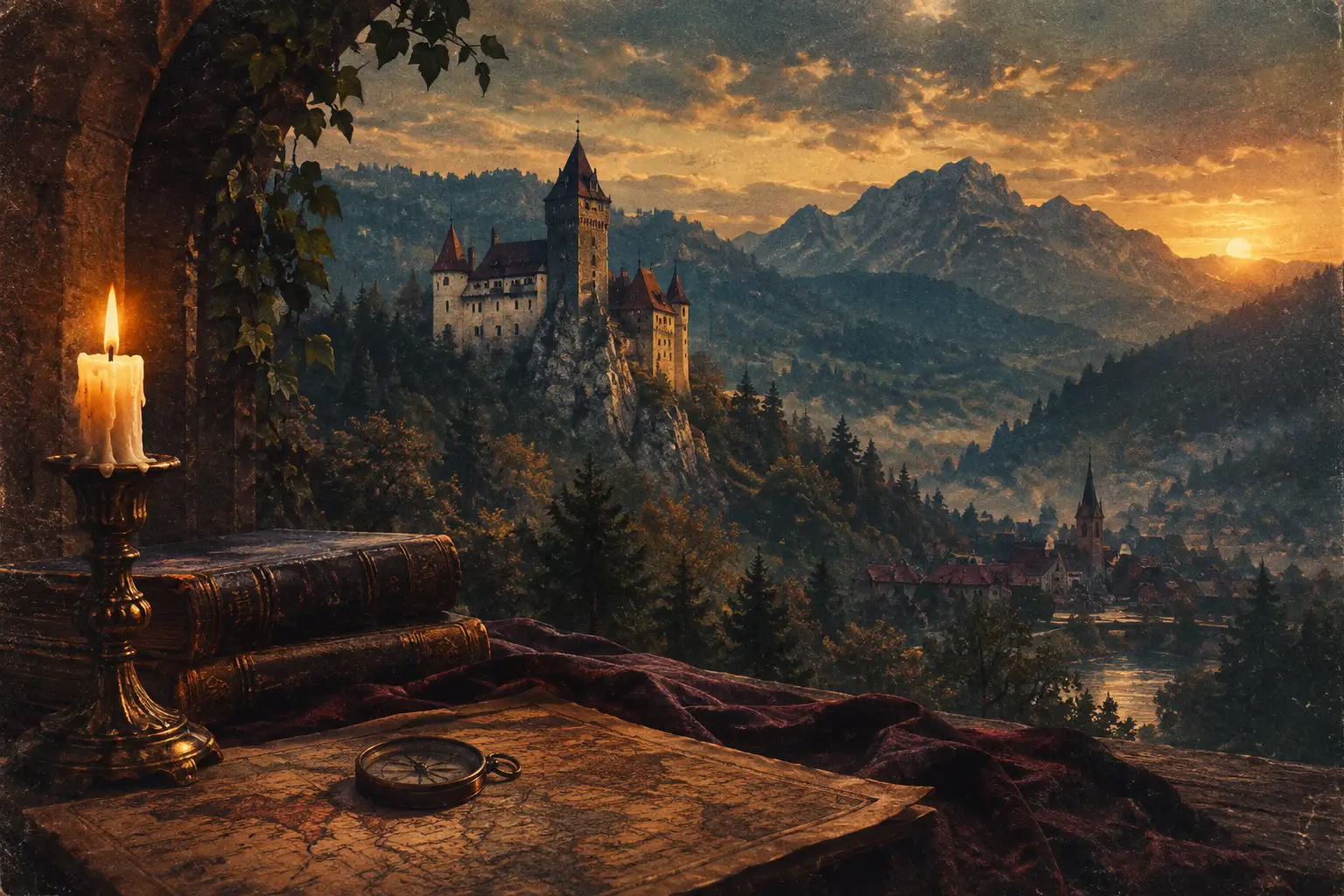
Bran Castle is about a 40-minute drive from Brașov, and yes, you should go. It is visually splendid: a 14th-century fortress perched on a rock, with steep roofs, twisting rooms, and an aggressively photogenic profile. If the itinerary has one place where your inner twelve-year-old gets to wear a cape in spirit, it is this.
Just bring historical guardrails. Bran Castle has no documented direct connection to Vlad the Impaler, and it does not closely match the castle described in Stoker’s novel. Its Dracula reputation grew substantially through 20th-century tourism, which is not a crime. We are genre people. We understand the value of a good legend. But calling it “Dracula’s castle” without qualification sands off the more interesting story: a strategic medieval stronghold that became a royal residence and later a global Gothic icon.
After Bran, consider the nearby Râșnov Fortress if weather and time cooperate. Then return to Brașov for another night rather than tackling a long drive in the dark. This is not cowardice. This is how the sensible final girl gets home.
Day 7: The Carpathians and a last look back
Take the scenic route south toward Bucharest if your departure is the next day, ideally along the Prahova Valley. Depending on season, road conditions, and timing, you may stop at Sinaia’s Peleș Castle. It is not medieval Gothic in the strict sense, but its 19th-century historicist splendor belongs to the same grand, candlelit family tree.
If you are flying from Cluj instead, reverse the route and give yourself a final night there. Do not build an itinerary around a single dramatic road such as the Transfăgărășan. It is spectacular when open, but it is seasonal and weather-dependent. Mountains have never cared about our content calendars.
Practical notes for gothic-minded travelers
Late September through October is a strong choice for golden leaves, colder evenings, and the appropriate amount of fog. May and June bring greener hills and longer daylight. Winter can be beautiful but requires more flexibility for driving, closures, and snow. Halloween itself may sound irresistible, yet it can mean higher crowds around Bran and Brașov. Choose it for the communal spooky-season energy, not for solitude.
Bring shoes with grip, a rain layer, and clothing you can layer for churches, hill climbs, and chilly stone interiors. Keep some Romanian lei on hand for small purchases, although cards are widely accepted in cities. Learn a few Romanian greetings, be respectful in active religious spaces, and remember that people live beside these castles and churches. The region is not a themed haunted house. That is precisely why it has such power.
Leave room for the unplanned hour: a village bakery, a fogged-up bus window, a bell ringing over a square after sunset. That is where Transylvania stops being a borrowed movie image and becomes a place you will carry home with you.


 Prev Post

What do you think?
Show comments / Leave a comment