





 November 14, 2026
The forgotten 1950s creature features are not merely the films with rubber suits, oversized mandibles, and posters that promised a very nervous afternoon. They are the strange little joints in the skeleton of monster cinema: cheap enough to take chances, serious enough to mean something, and often far more interested in worried working people than in spotless military heroes. Put one on during a dark winter night and you can still feel the Atomic Age humming behind the wallpaper.
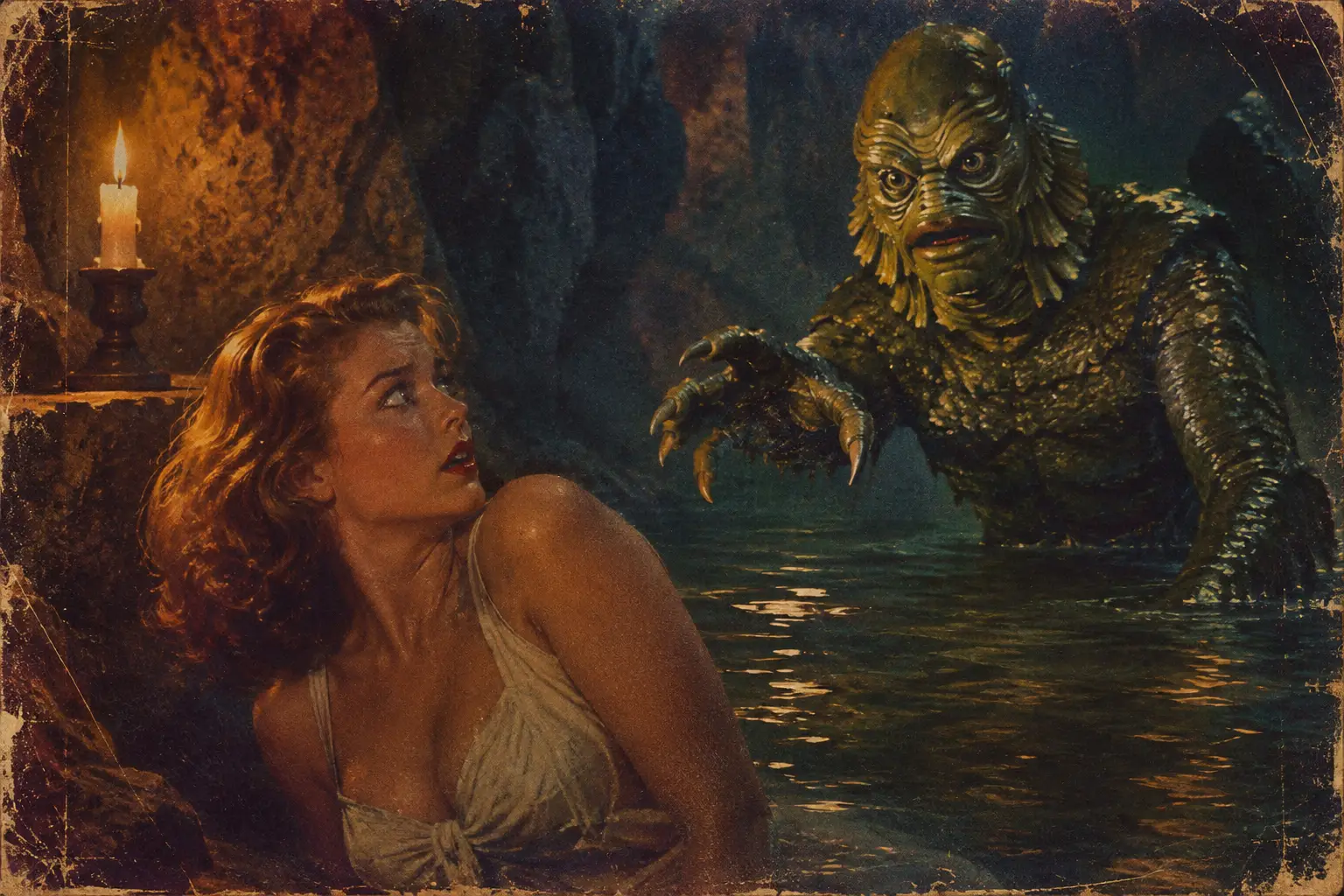
The obvious giants of the decade have never left us. Them! gets booked for repertory screenings. Creature from the Black Lagoon has its place in the Universal Monster family crypt. But the lower-billed cousins deserve their own candlelit table. These films preserved Cold War dread, ecological unease, regional American textures, and a very particular faith that a scientist, a sheriff, and one exhausted couple could maybe handle an impossible animal before supper.
Why forgotten 1950s creature features still matter
Calling these movies “bad” because a matte line wanders or a monster has an ambitious face is the laziest trick in the criticism playbook. A creature feature lives or dies by atmosphere, conviction, and the quality of its anxiety. A production can have a wobbly beast and still understand exactly how frightening it is to discover that modern expertise has failed at the edge of town.
That is the secret weapon of the era. The monster is rarely just a monster. It is radiation, industrial expansion, wartime science coming home with mud on its boots, or plain old human overconfidence. The films do not always articulate that elegantly. Sometimes they articulate it with a scientist pointing at a chalkboard while a creature attacks a quarry. We love them for trying.
They were also made for a changing exhibition world. Television had pulled audiences into the living room, studios were trimming budgets, and drive-ins needed colorful promises on a marquee. That pressure produced shortcuts, certainly, but it also created compact movies with no time for prestige furniture. When the creature arrives, the movie usually gets on with it.
Seven creature features that slipped through the cracks
This is not a ranking. It is a starter path for viewers who want the mood, the oddities, and the historical texture without treating these films like ironic punishment.
The Monster That Challenged the World (1957)
Universal’s The Monster That Challenged the World begins with a premise so gloriously specific it could only have come from this decade: ancient mollusks awakened beneath Southern California’s Salton Sea. Director Arnold Laven gives the picture more desert-and-water atmosphere than its reputation suggests, while the cast plays the emergency with a pleasingly straight face.
The creature design is a good example of what these movies understood. It is not elegant in the Universal Gothic sense. It is clammy, bulky, and wrong, like something that ought to remain below the mud forever. The Salton Sea setting also gives the film a faintly haunted regional quality. This is not outer space landing in a generic suburb. It is American geography becoming unfamiliar.
The Deadly Mantis (1957)
A giant insect near the Arctic was hardly an unusual pitch in 1957, but The Deadly Mantis has a chill that outlasts its recycled military footage. Produced by Universal-International, it turns polar isolation into a menace all its own. The mantis is frightening because it belongs to no negotiable human system. You cannot reason with it, bribe it, or file the appropriate paperwork.
Yes, the effects vary. That is not a revelation worthy of a trumpet blast. What works is the film’s vision of defense infrastructure stretched thin across an enormous, hostile landscape. It feels like a Cold War nightmare in which the radar station has spotted something, but nobody has enough coffee or authority to make it go away.
The Black Scorpion (1957)
If you want a more tactile monster movie, find The Black Scorpion. Its giant arachnids emerged from the creative orbit of special-effects pioneer Willis O’Brien, with Pete Peterson handling much of the stop-motion work. The result has a handmade, skittering energy that digital polish would sand right off.
Set in Mexico, the film uses volcanic upheaval as more than a convenient excuse for bugs to become large and rude. The earth itself has become unstable. That gives the picture a mythic undertow, even as it delivers the vital business of scorpions causing civic inconvenience on an epic scale. Its miniature work and stop-motion photography make it essential viewing for anyone who likes their monsters to look physically present, however improbable their day planner may be.
The Giant Claw (1957)
No honest historian should pretend The Giant Claw is a flawless lost masterpiece. The title bird, an alien called the Mitchum Bird by generations of affectionate viewers, looks spectacularly unpersuaded by earthly anatomy. And yet the movie has a weird, nervous power. It imagines the United States under attack by something so absurd that conventional defense systems cannot even classify it.
That absurdity is the point. Columbia producer Sam Katzman’s film is a lesson in how an image can become a cult object precisely because it refuses to behave. Jeff Morrow and Mara Corday play the material with admirable commitment, which keeps the whole thing from collapsing into a gag. Watch it with friends, but do not watch it merely to sneer. The film has earned more tenderness than that.
The Unknown Terror (1957)
The Unknown Terror is the picture to choose when you want your Atomic Age panic served damp. Directed by Charles Marquis Warren, it sends its characters into a cave system where a strange fungus turns exploration into biological nightmare. The setting matters as much as the creature business: caves make science feel small, temporary, and deeply underprepared.
The movie belongs to the 1950s cycle of subterranean fears, where the world beneath our feet becomes a repository for everything polite civilization has failed to understand. Its title may sound generic, but its mood is not. There is a dank, low-budget Gothic quality here, halfway between a monster serial and a fever dream after too much drive-in popcorn.
The Trollenberg Terror (1958)
Released in the United States as The Crawling Eye, this British production brings the creature feature into a fog-bound mountain setting. That shift is crucial. Instead of American highways and laboratories, you get an Alpine resort trapped beneath an unnatural cloud. The setting gives the film the cozy-gothic pleasure of a locked-room mystery, except the room is a mountain and the lock is extraterrestrial weather.
For American viewers, its transatlantic flavor can be part of the pleasure. It is a reminder that Cold War monster anxiety was never exclusively a Hollywood export. The monsters may be pulpy, but the feeling of watching ordinary routines buckle under an incomprehensible threat travels very well.
The Killer Shrews (1959)
Ray Kellogg’s The Killer Shrews is a small, salty, storm-lashed creature feature that understands the value of being trapped somewhere unpleasant. Its miniature monsters were created with dogs in costume, a decision that has made the movie a punch line for decades. Fair enough. The costumes are not exactly subtle.
But look past the obvious gimmick and you find a survival story with a surprisingly grim environmental premise. The film is interested in scientific meddling and its consequences, not as a grand lecture but as a pressure cooker. It also has the kind of isolated coastal setting that makes a black-and-white movie feel like it has been filmed inside a wet nightmare.
How to watch the weird ones well
Do not treat every 1950s creature feature as interchangeable background noise. Pair a stop-motion picture like The Black Scorpion with a suit-and-miniature movie like The Monster That Challenged the World, and the era’s range becomes clearer. One is fascinated by the craft of movement; the other gets its force from weight, location, and the ugly plausibility of something ancient surfacing nearby.
It helps to watch the trailers and posters after the film rather than before it. The advertising often sold hysteria, while the movies themselves offered something more interesting: earnest technicians, strange landscapes, and an abiding suspicion that progress has left a door open somewhere. That contrast is half the fun.
Give these films the conditions they deserve: a late hour, a warm drink, a screen bright enough to catch every suspiciously luminous blob, and company willing to admire a brave idea even when the budget loses the wrestling match. The forgotten corners of the 1950s are full of monsters still waiting for someone to take them seriously enough to enjoy them.


 Prev Post

What do you think?
Show comments / Leave a comment