





 November 20, 2026
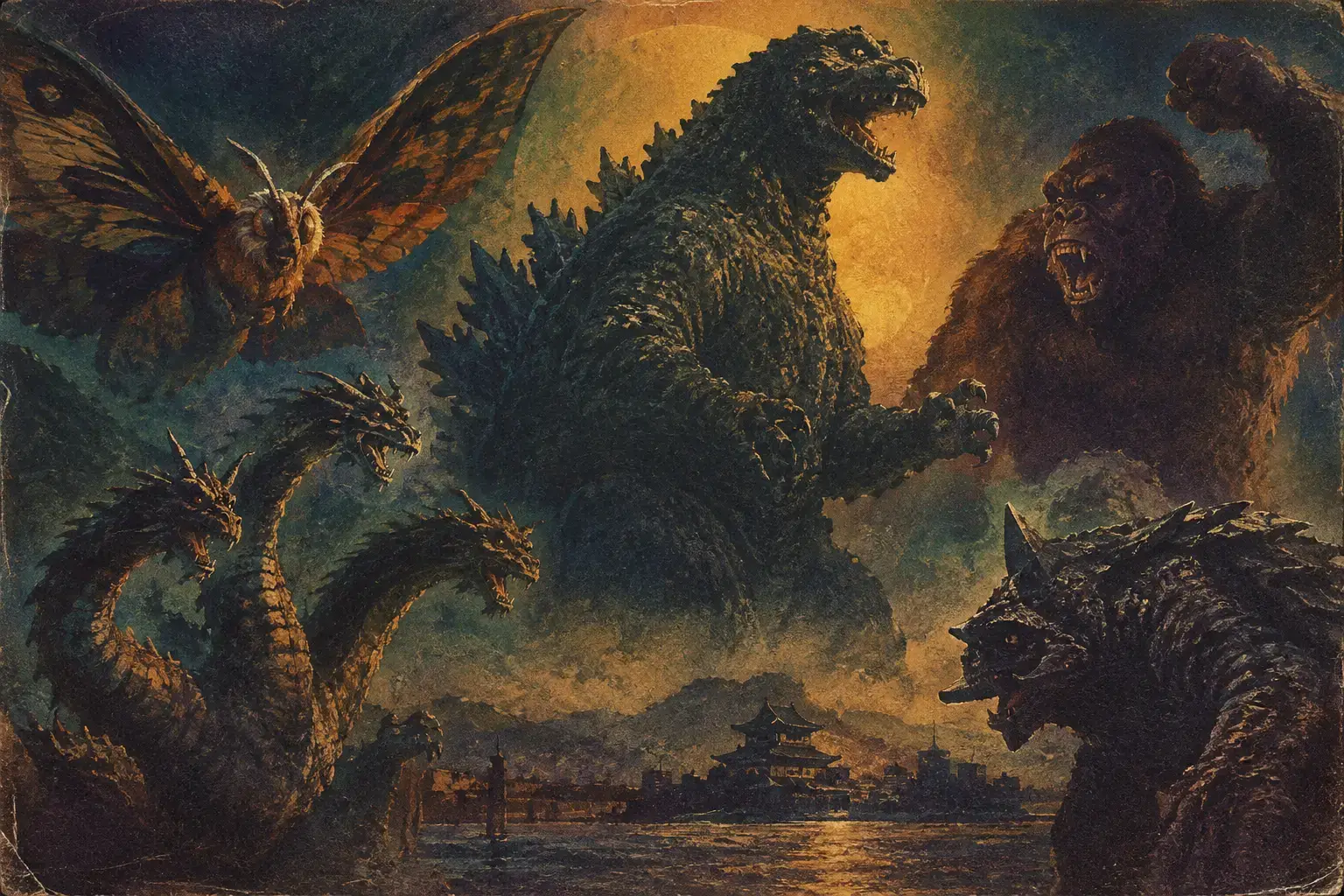
Before Tokyo became the world’s most repeatedly demolished metropolitan area, giant monsters were already stomping through cinema with muddy feet, clacking jaws, and a surprising amount of emotional baggage. The essential kaiju films before Godzilla are not simply a set of old movies with oversized animals in them. They are the strange, often beautiful experiments that gave Gojira its visual language – then left it to Ishiro Honda and Eiji Tsuburaya to turn that language into an atomic funeral bell.
That distinction matters. Godzilla did not invent the giant-monster movie from scratch, despite what a tidy timeline might suggest. It inherited stop-motion sorcery, jungle spectacle, prehistoric awe, and Cold War nerves. What it changed was the feeling. Earlier giant creatures were often marvelous obstacles or rampaging attractions. Godzilla arrived carrying national trauma on its scaly back.
Why pre-Godzilla monster movies still matter
Calling every earlier giant-creature picture a kaiju film is a little historically slippery. Kaiju, meaning “strange beast,” became genre shorthand through Japanese monster cinema, and the familiar kaiju formula had not fully hardened into place before 1954. But if you want to understand why Godzilla landed with such force, these are the films to put in the projector first.
They show us the ingredients before the recipe became legend: animation, miniatures, crowds fleeing in organized panic, scientists warning officials who would rather be anywhere else, and nature becoming too large to politely contain. Some have aged more gracefully than others. A few are very much products of their moment. That is part of the charm. Old monster movies do not need to be polished to be alive.
The essential kaiju films before Godzilla
The Lost World (1925)
Harry O. Hoyt’s adaptation of Arthur Conan Doyle is the primordial soup of big-screen creature features. Willis O’Brien’s stop-motion dinosaurs were not the first trick effects in movies, but they gave audiences an unnerving new sensation: creatures with weight, movement, and apparent temperament sharing the frame with human beings.
The film’s creatures can seem delicate now, especially if you have spent years watching monsters flatten high-rises in digital surround sound. Look closer. O’Brien understood that a monster must feel like it occupies space. His dinosaurs push through foliage, react to threats, and create disorder wherever they go. That basic illusion – a living impossible thing loose in our world – is the foundation beneath every suit, puppet, miniature, and motion-capture beast that followed.
It is also worth remembering how quickly the monster escapes the “lost” place. The modern city was already becoming a playground for prehistoric panic. Tokyo would eventually make that idea permanent.
King Kong (1933)
If The Lost World established the technique, King Kong established the emotional stakes. Merian C. Cooper and Ernest B. Schoedsack’s film made a giant creature into a personality: fierce, curious, territorial, frightened, and ultimately tragic. The monster was spectacle, certainly, but he was never just scenery with teeth.
That is one of the deepest roots Godzilla shares with Kong. The two icons take very different paths, and the 1954 Godzilla is far less interested in being cuddly than later versions might be. Still, each asks you to feel the terrible mismatch between a colossal creature and a human civilization determined to capture, categorize, or destroy what it cannot control.
Kong also codified a visual grammar that later kaiju cinema would make its own: scale achieved through miniature environments, tiny humans framed against giant anatomy, and a city turned into a vulnerable toy box. The Empire State Building finale is not just famous because it is dramatic. It is a perfect image of modernity discovering it is not as mighty as it assumed.
Son of Kong (1933)
Yes, this is the odd little cousin at the family reunion. Released the same year as King Kong, Son of Kong was made quickly, more modestly, and with a considerably lighter touch. But it earns its place here because it reveals how early monster cinema was already negotiating a problem kaiju franchises would face for decades: what happens after audiences have met the big beast?
The answer, at least here, is to alter the creature’s emotional register. Kiko is smaller, paler, and more openly sympathetic than Kong. The film treats the giant ape less as an unknowable force and more as a companionable fantasy figure. That move would echo through later Japanese monster movies, where Godzilla and his colleagues could shift from horrors to guardians, wrestlers, parents, and occasionally what appears to be a very grumpy uncle at a children’s birthday party.
It is not as artistically unified as King Kong. Few films are. But it is a useful reminder that monster mythology became serialized almost immediately.
One Million B.C. (1940)
Hal Roach’s One Million B.C. is a cave-person adventure with dinosaurs supplied by Victor Mature, Carole Landis, and a menagerie of real reptiles wearing questionable prosthetics. No, that sentence does not get less charming with age.
The film belongs here not because its effects are subtle – they are gloriously, aggressively not – but because it captures a key giant-monster instinct: the prehistoric world as a place where humans are suddenly small again. Long before radiation mutated anything, the screen monster represented nature at a scale human confidence could not manage.
There is a useful trade-off in watching it. You may laugh at the lizards in horns. Please do. But do not miss the atmospheric idea beneath the rubber and glue. Monsters make the world feel old, hostile, and indifferent to us. Godzilla would later give that feeling a modern source and a much sharper political edge.
Unknown Island (1948)
Unknown Island is one of those glorious titles that tells you exactly what sort of evening you are having. It is a low-budget jungle expedition picture with dinosaurs animated by Ray Harryhausen, working early in his career with producer Sam Katzman.
Harryhausen’s creatures do not yet have the astonishing refinement of his later work, but you can see the essential principle taking shape: monsters are actors. Their movements need rhythm, reaction, and just enough personality to make a confrontation feel like an event rather than a special-effects demonstration.
That lesson traveled far. Japanese monster cinema would solve the same challenge differently, using suit performance and miniature craftsmanship rather than stop-motion for Godzilla himself. Yet the goal was shared. A giant creature must be more than large. It must have a presence. It needs to enter a scene as if the room has changed temperature.
The Beast from 20,000 Fathoms (1953)
Here is the immediate pre-Godzilla landmark, and it is impossible to discuss the lineage without it. Directed by Eugène Lourié and animated by Harryhausen, The Beast from 20,000 Fathoms gives us a prehistoric reptile awakened by an atomic test and headed toward a major American city. The parallels are real. Pretending otherwise is the kind of trivia-night confidence that gets a person gently escorted away from the snack table.
But similarity is not sameness. The Beast is a brisk Atomic Age creature feature, shaped by American fears about scientific consequences and metropolitan vulnerability. Gojira took related materials – radiation, a prehistoric survivor, an endangered city – and filtered them through Japan’s postwar experience, including the memory of Hiroshima and Nagasaki and the 1954 Lucky Dragon No. 5 nuclear exposure. The result was not merely a bigger monster movie. It was a national nightmare given a body.
Watch The Beast for the bridge it provides. Its real historical value is showing that the atomic monster had already entered the public imagination, waiting for a filmmaker to make it mournful as well as frightening.
Them! (1954)
Released months before Gojira, Gordon Douglas’s Them! is not a kaiju film in the Japanese sense, but it is essential monster grammar. Its irradiated giant ants bring the atomic threat down to ground level, turning the desert, storm drains, and city infrastructure into potential nests for something unstoppable.
What makes Them! endure is its seriousness. It does not wink at its premise. The cast plays the crisis straight, and the film understands that giant-monster terror works best when institutions struggle to name the problem before they can fight it. Scientists, police, military personnel, and civilians all become part of the machinery of alarm.
Godzilla would make the monster larger and its symbolism deeper, but Them! proves that the atomic creature feature could carry adult dread without losing its Saturday-matinee charge. That balance is harder than it looks.
Watch the lineage, not just the lizard
A good pre-Godzilla marathon should not be a homework assignment conducted under fluorescent lights. Start with The Lost World or King Kong on a dark winter night, let The Beast from 20,000 Fathoms carry you into the atomic era, then watch the original 1954 Gojira when you are ready to feel the floor drop out from under the genre.
You will see the old tricks, the miniature streets, the anxious scientists, and the giant footprints. You will also see why Godzilla became more than the sum of them. The earlier monsters taught cinema how to make us stare upward. Godzilla taught it why we were afraid to look.


 Prev Post

What do you think?
Show comments / Leave a comment