





 July 27, 2026
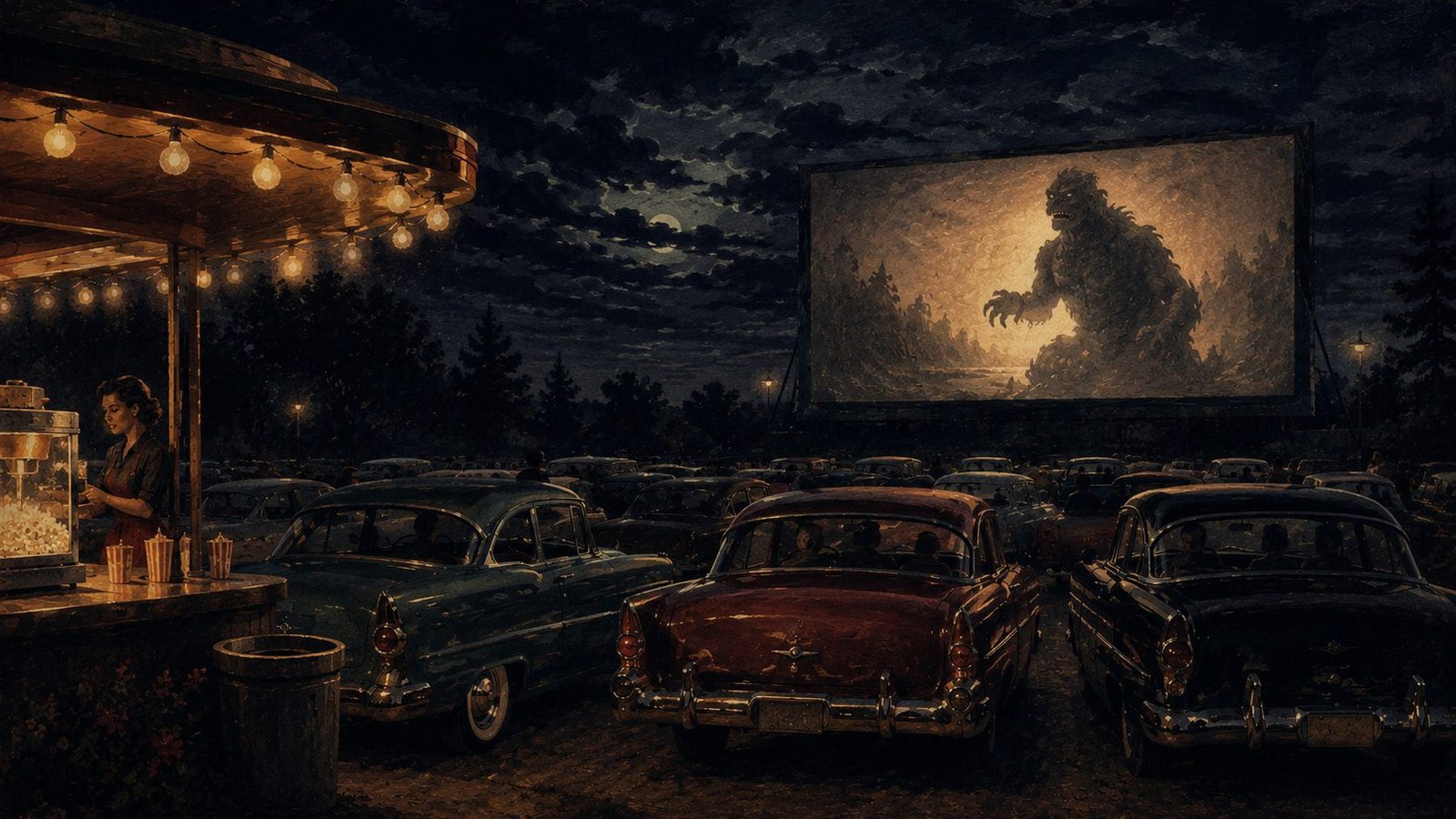
There is a particular kind of dark that only exists in a parking lot full of strangers, all facing the same direction, waiting for something enormous to flicker to life. Not the dark of a bedroom at midnight, not the dark of a theater with assigned seats and a hushed usher, the dark of a summer field turned cathedral, engines ticking as they cool, a hundred private conversations happening behind a hundred windshields, and somewhere above all of it, a giant ant, or a creature from a lagoon, or a blob that will not stop growing.
The drive-in double feature wasn’t just a way to watch two movies. It was a whole grammar for how monster stories got told, and it’s a grammar we’ve mostly forgotten, even though its fingerprints are still all over the genre we love.
The Ritual Was the Point
It’s tempting to think of the drive-in as a delivery system, a slightly inconvenient way to watch the same film you could’ve seen indoors. But the ritual around the films did as much storytelling as the films themselves. The intermission cartoons counting down to a hot dog with legs. The tinny speaker clipped to the window, mono sound flattening a monster’s roar into something almost intimate, like it was happening inside the car with you. The fact that you weren’t really watching at the screen so much as watching within an evening, one that included your friends in the back seat, the smell of popcorn and cut grass, the specific anxiety of a bug landing on the windshield right as something worse crawled across the screen.
Atomic Age creature features were built, whether their studios fully realized it or not, for exactly this kind of half-attention, communal, slightly sticky viewing. A film like Them! (1954) doesn’t ask you to sit in reverent silence; it asks you to gasp with the car next to you, to feel the collective jolt ripple across a hundred windshields at once. The horror was social before it was ever personal. That’s a different kind of scare than the one we chase today, and it’s worth remembering that “cozy” and “communal” aren’t opposites; they’re often the same thing wearing different coats.
Why the “B” Picture Got to Be Strange
Every double bill had a hierarchy: an “A” picture with a recognizable star or bigger budget, and a “B” picture that ran underneath it like the fine print. But the B slot wasn’t a punishment. It was closer to a permission slip. Because expectations were lower and budgets were smaller, B-pictures could take the kind of swings an A-picture never would: a man shrinking to the size of a spider, a woman who’s married a creature and doesn’t entirely regret it, a giant reptile that’s really a metaphor for something the studio wouldn’t say out loud in 1954.
This is the lineage Cafe Crashdown keeps circling back to, because it’s the whole reason drive-in schlock deserves real reverence rather than a knowing smirk. The B-picture’s freedom to get weird is the direct ancestor of the low-budget horror renaissance we still lean on today, the Chopping Malls and Basket Cases of the world, right up through the scrappy indie horror still finding distribution now. When a studio has nothing riding on prestige, the monster gets to be sadder, funnier, sexier, more sincere. The B-picture is where horror historically got to have a heart.
What the Format Shaped, Even When You Weren’t Looking
The double feature also shaped storytelling in ways that had nothing to do with theme and everything to do with pacing. Films were cut lean because they had to share a runtime slot with concession-stand ads, cartoon shorts, and a second feature. There wasn’t room for a slow burn the way a modern two-hour arthouse horror film can afford one. A creature had to show up. Something had to go wrong fast, because the whole economy of the evening- snacks sold, cars filled, second show timed just right before the projectionist could go home- depended on momentum.
That constraint produced something we still feel today whenever a monster movie gets criticized for “showing the creature too early.” Atomic Age sci-fi didn’t have the luxury of coy restraint, and in exchange, it built stories where the monster’s existence wasn’t the twist; the monster’s meaning was. We weren’t there to find out if something was in the lagoon. We already knew. We were there to find out what it wanted, what it feared, and whether we were the villains of its story rather than the other way around.
What’s Lost, Watching Alone
There’s real pleasure in watching these films now, a laptop glow, a good pair of headphones, total control over the pause button. But something does go quiet in that solitude. The communal gasp is gone. The soft mockery from someone else’s car three spaces over, laughing not at the monster but with the whole absurd tenderness of loving something this strange, is gone. Watching alone, we get precision. Watching together, under a real sky, we got something closer to devotion, a shared agreement, unspoken, that for the next ninety minutes we would all take the ridiculous thing completely seriously.
Cafe Crashdown exists, in part, to try to rebuild a little of that feeling indoors, the blanket instead of the windshield, the string lights instead of the drive-in marquee, the sense that watching a monster movie is something you do with people, even if those people are only reading along with you.
A Small Ritual, Recovered
Maybe that’s the real inheritance of the double feature, not the format, which mostly couldn’t survive real estate prices and streaming convenience, but the instinct underneath it. The idea that a monster movie is better as a shared occasion than a solitary consumption. That the ninety minutes before the film even starts, the setup, the snacks, the settling in, are not a delay before the story, but the first act of it.
So maybe tonight, wherever you’re watching from, don’t just press play. Build the ritual back in, however small. Dim the lights. Pick the strange one, the B-picture nobody quite remembers correctly. Let someone else’s laughter, even from another room, be part of the show.
What’s your version of the drive-in ritual these days — the movie you always pair with something else, the snack that has to be there, the friend who has to be texted the second the creature shows up? I’d love to hear it.


 Prev Post