





 November 4, 2026
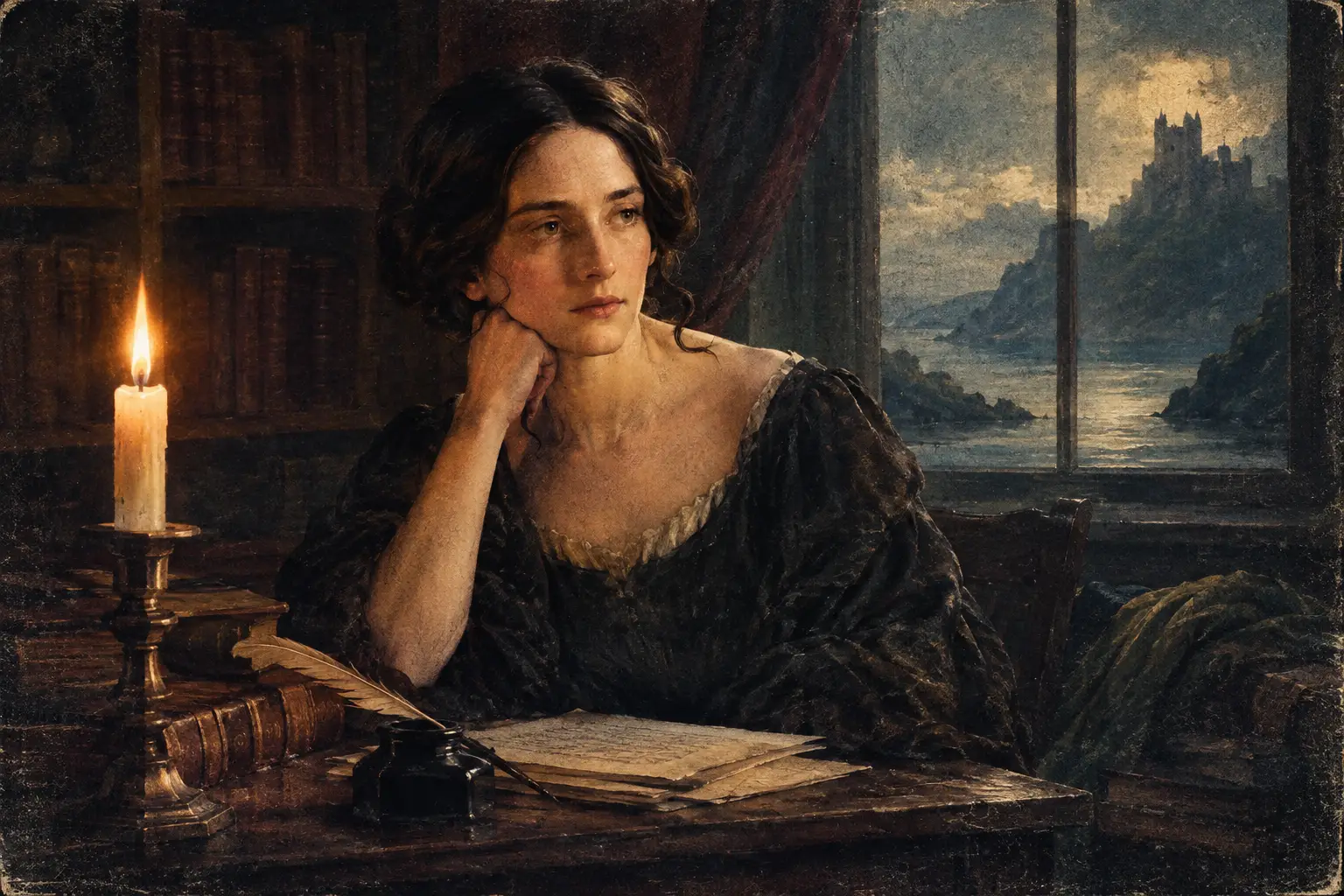
A candlelit villa on Lake Geneva, a summer with almost no summer, and a circle of brilliant young people trying to scare each other: the Mary Shelley Frankenstein historical context is already better than most movie origin stories. But the familiar ghost-story contest is only the lightning flash. The real electricity was everywhere in Mary Shelley’s life – in laboratories, graveyards, radical politics, family tragedy, and a Europe still staggering after revolution and war.
Frankenstein; or, The Modern Prometheus arrived in 1818, not as a quaint old warning about people meddling in God’s business, but as a fiercely modern nightmare about creation without care. That distinction matters. The novel is not afraid of science. It is afraid of ambition that refuses to answer for what it makes. A lesson Hollywood has occasionally misplaced while busy finding more things to bolt to a laboratory table.
Mary Shelley Frankenstein Historical Context: A World Gone Strange
Mary Shelley was born Mary Godwin in 1797, into an intellectual household with a shadow over its doorstep. Her mother, the writer and women’s-rights pioneer Mary Wollstonecraft, died days after giving birth to her. Her father, philosopher William Godwin, argued for reason, education, and political reform. Mary grew up around writers, arguments, debts, and the very unfashionable idea that young women might have minds worth developing.
That inheritance sits deep inside Frankenstein. The novel keeps asking who owes care to whom: parents to children, communities to the excluded, creators to their creations. It does not offer easy answers, because Mary’s own world had offered her very few. By the time she began the book, she had endured the death of her first child and the instability of a life shaped by social disapproval, money worries, and the restless orbit of Percy Bysshe Shelley.
Then came 1816, remembered as the Year Without a Summer. The 1815 eruption of Mount Tambora in present-day Indonesia blasted enough material into the atmosphere to disrupt weather around the globe. Europe saw cold, rain, failed crops, and dim skies. In Switzerland, the weather repeatedly trapped Mary, Percy, Lord Byron, Byron’s physician John Polidori, and Mary’s stepsister Claire Clairmont indoors at the Villa Diodati.
That famously miserable weather did not hand Mary a finished novel. It did, however, create the perfect Gothic pressure cooker: volcanic gloom outside, ghost stories and scientific conversation inside, and a generation already acquainted with catastrophe. Frankenstein feels born from bad weather because, in a sense, it was. Its landscapes are not decorative wallpaper. Ice, storms, mountains, and isolation reflect a world that no longer feels stable or safely ordered.
Science Was Not Fantasy in 1818
For modern readers, Victor Frankenstein’s experiment can seem like science fiction in the sleek, futuristic sense. Mary Shelley’s original audience encountered something more unsettling: a fictional extension of real scientific debates.
The late eighteenth and early nineteenth centuries were buzzing with arguments about life itself. Luigi Galvani’s experiments with frog legs had helped popularize the notion that electricity might animate muscle. His nephew, Giovanni Aldini, carried the spectacle further with electrical demonstrations on animal and human bodies, including the corpse of an executed criminal in London in 1803. Reports described facial movement and limbs stirring under current. No, Aldini did not raise the dead. But he gave the public a deeply memorable image of electricity making a dead body appear startlingly responsive.
Meanwhile, natural philosophers debated vitalism – the belief that living things possessed some special life force – against increasingly material explanations of the body. Anatomy was advancing, medical schools needed cadavers, and grave robbing was a grim fact of urban life. The respectable parlor and the dissecting room were not as far apart as polite society liked to pretend.
Mary also knew the work of Erasmus Darwin, physician, poet, and grandfather of Charles Darwin. Later accounts associated him with experiments and speculation about life’s processes. Shelley’s 1831 introduction mentions Darwin as part of the conversations surrounding her idea, though readers should resist turning him into a tidy one-man source for the novel. Frankenstein is not a coded report from one laboratory. It is a Gothic argument built from the era’s scientific anxieties.
The key fear was not simply that science could do too much. It was that a person with knowledge, privilege, and ego could act first, then treat the consequences as somebody else’s mess. That is still a live wire.
The “Modern Prometheus” Was a Warning Label
Mary Shelley’s subtitle points to the Greek figure Prometheus, who gave fire to humanity and suffered punishment for it. In the Romantic period, Prometheus was often admired as a rebel against tyranny and a champion of human progress. Percy Shelley would later make him the heroic center of Prometheus Unbound.
Mary’s version is thornier. Her modern Prometheus does not generously share a gift with humanity. He makes a private bid for glory and fails at the first moral obligation of creation: staying in the room.
That is why reducing the book to science-bad, nature-good misses its deliciously unpleasant point. Knowledge is not the monster. Neglect is. The novel asks what happens when a creator wants the applause of making something new but not the difficult, unglamorous labor of responsibility afterward. There is no thunderclap more Gothic than that.
Revolution, Industry, and the Outsider
The novel also emerged from a Europe transformed by the French Revolution, the Napoleonic Wars, and the early Industrial Revolution. Mary’s parents had been associated with radical political thought, and the promise and disappointment of revolution haunted her generation. Grand ideals could topple old systems. They could also leave bodies in the street.
That political weather helps explain why Frankenstein is so suspicious of isolated greatness. Its characters are drawn to sublime ambition, private suffering, and heroic self-definition – all classic Romantic material. Yet the novel repeatedly returns to the damage done when people refuse mutual obligation. Nobody gets to be a lone genius for free.
Industrial change sharpened that concern. Britain’s factories, expanding cities, and new machines were rearranging work and social life. The Luddite disturbances of 1811 to 1816 showed that workers were not thrilled to be treated as disposable parts in someone else’s progress machine. Mary Shelley was not writing an anti-factory pamphlet, and trying to force every Gothic lightning bolt into a steam-engine metaphor gets silly fast. Still, the novel belongs to an age asking whether progress serves human beings or merely uses them up.
Its creature is therefore more than a spooky figure at the window. He is an outsider made visible – denied family, status, education, and welcome, then judged for the consequences of that exclusion. For a writer raised among political reformers, that is not an accidental concern. The novel’s deepest horror is social as much as supernatural: people see suffering, decide it is inconvenient, and call the result inevitable.
Why Mary Shelley Published Anonymously
The first edition of Frankenstein appeared anonymously in January 1818. Percy Shelley wrote the preface, and that fact helped fuel an enduring bad take that he must have written the novel. He did not. Mary Shelley’s drafts, revisions, correspondence, and later career make her authorship unmistakable. Percy offered editorial input, as literary partners often did, but the book is Mary’s.
The anonymity tells us something important about the period. Women wrote and published, of course, but serious literary authority was still guarded like a family crypt. A sensational philosophical novel by a very young woman, living outside conventional respectability with a notorious poet, was likely to receive a different kind of scrutiny. Anonymous publication gave the book a little protective fog.
It also created an ironic afterlife. A novel about a creator losing control of her creation was quickly pulled away from its author in public conversation. By the 1830s, stage adaptations had already turned the story toward visual spectacle, and later film versions would make the stitched, square-headed monster an icon. We love that icon around here. But the 1818 novel remains stranger, sadder, and far more interested in abandonment than in apparatus.
Read the 1818 Novel With the Storm Clouds Still Overhead
The 1831 edition is the version many readers first encounter, partly because it includes Mary Shelley’s famous account of the Geneva summer. It is valuable, atmospheric, and impossible to ignore. But the 1818 text often lands with a sharper political edge and a younger writer’s urgency. If you can, spend time with both. They are not rival camps in a monster-fight bracket; they reveal how Mary reconsidered her work across thirteen eventful years.
Reading Frankenstein in historical context does not drain away its spooky-warm Gothic power. It gives the novel more rooms to haunt. Behind the lightning are medical theaters, revolutionary dreams, volcanic skies, a young mother’s grief, and a woman writer insisting that creation has consequences.
So the next time a screen Frankenstein starts cranking a suspicious amount of electrical equipment, enjoy the sparks. Then return to Mary Shelley’s colder question: after the miracle, who is willing to take responsibility for the living thing left at the door?


 Prev Post

What do you think?
Show comments / Leave a comment